ChatGPT showing ads is now a reality for millions of free users worldwide, and if you have noticed something new appearing below your answers, you are not imagining it. ChatGPT is showing ads, and millions of free users around the world are now seeing sponsored placements inside their conversations.
This is one of the biggest changes to hit the AI tools space in 2026. OpenAI spent years insisting that advertising was a last resort. Then, on February 9, 2026, the company launched its ad pilot for free users in the United States, and the rollout has been expanding rapidly ever since.
This article covers everything you need to know: what the ads look like, which users see them, how OpenAI targets them, whether you can turn them off, and what your alternatives are if you would rather use an AI tool without sponsored content.
Table of Contents
ToggleWhy ChatGPT Is Showing Ads
| ChatGPT Plan | Monthly Price | Sees Ads | Image Generation | Best For |
|---|---|---|---|---|
| Free | $0 | Yes | Limited | Casual users |
| Go | $8 | Yes | Yes | Light users |
| Plus | $20 | No | Yes (DALL-E) | Power users |
| Pro | $200 | No | Yes | Heavy users |
| Business / Enterprise | Custom | No | Yes | Teams |
The answer is straightforward. ChatGPT has over 800 million monthly active users and the vast majority of them pay nothing. Running the infrastructure that powers those conversations costs OpenAI billions of dollars per year. Subscription revenue from Plus and Pro users does not cover the full cost of serving hundreds of millions of free users at scale.
Advertising is how OpenAI bridges that gap.
OpenAI officially began testing ads in ChatGPT in February 2026, with a stated goal of supporting free access while preserving consumer trust and user control. The company framed it as a way to keep ChatGPT accessible without forcing every user onto a paid plan. OpenAI
Sam Altman, OpenAI’s CEO, had previously described advertising in ChatGPT as a last resort. The move represents a reversal of that position, driven by the economic pressure of running the most widely used consumer AI product in the world. harvard
Who Sees ChatGPT Ads and Who Does Not
This is the most important practical question, and the answer is clear.
Ads currently appear only for logged-in adult users in the United States on ChatGPT’s Free and Go tiers. Users on Plus, Pro, Business, Enterprise, and Education plans see no ads at all, according to OpenAI. Northeast Times
The Go plan, priced at $8 per month, sits in an unusual position. It is a paid plan, but it still carries ads. If your primary reason for avoiding ads is to not pay for something that then serves you advertising, the Go plan does not solve that problem. The Plus plan at $20 per month is the lowest tier with a completely ad-free experience.
As of August 11, 2026, ChatGPT ads have expanded beyond the United States and are now live in the United Kingdom, Mexico, Brazil, Japan, and South Korea. The rollout is continuing through the rest of the year, which means users in additional markets will encounter ads in the coming months. OpenAI
Chatgpt Showing Ads:What the Ads Actually Look Like
Knowing that ChatGPT is showing ads is one thing. Understanding what they look like in practice is another.
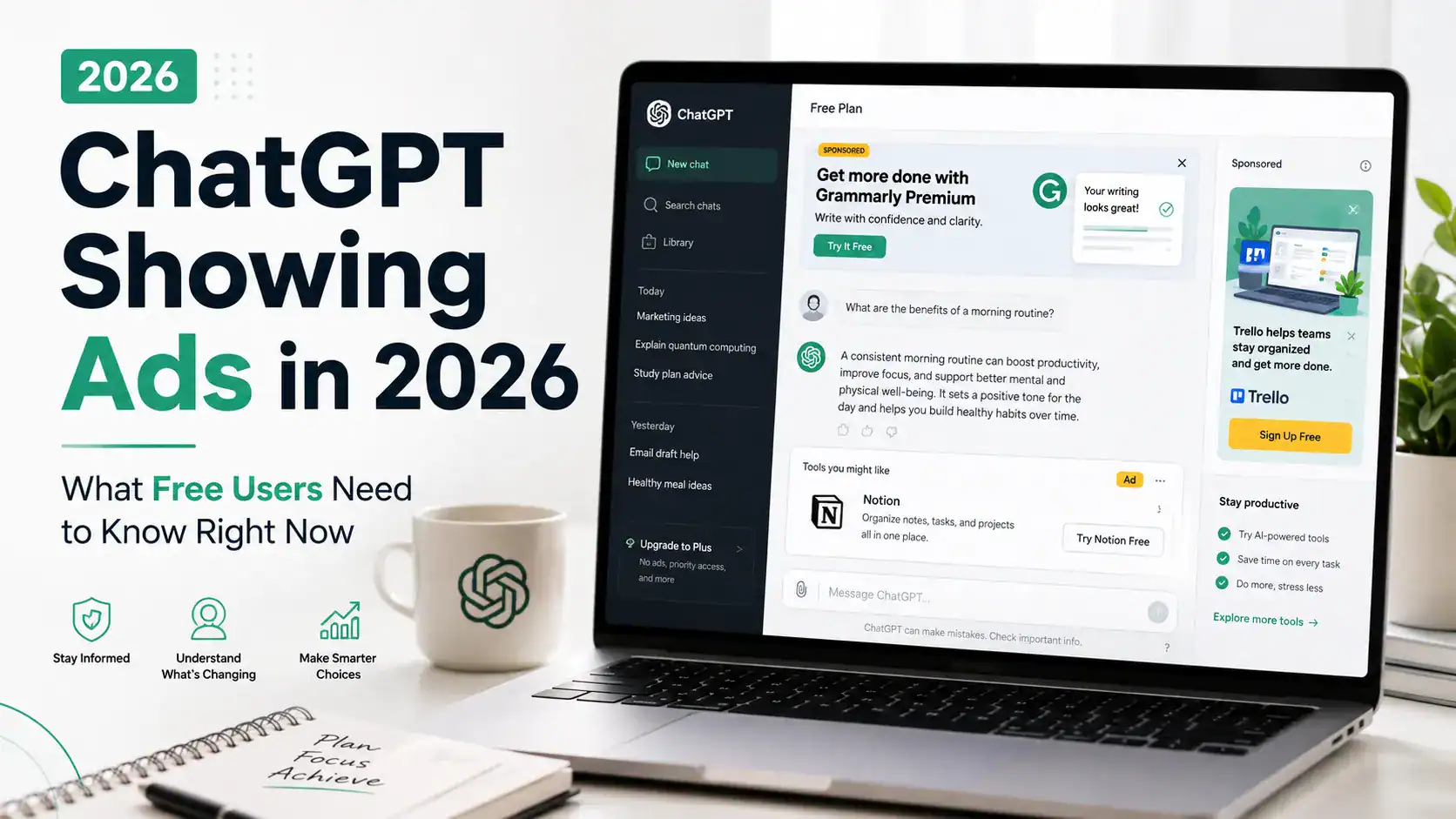
Two ad formats are currently live. The first is a shopping product carousel that appears beneath ChatGPT’s response when a user asks about products or shopping. The card shows a brand logo, a “Sponsored” label, a product name, price, stock status, and estimated delivery time. Northeast Times
The second format is a conversational ad that appears inline after a response, clearly labeled as sponsored and visually separated from the answer itself.
Ads do not influence the answers ChatGPT gives. Ads run on separate systems from the chat model, and advertisers have no ability to shape, rank, or alter ChatGPT’s responses. Every ad is clearly labeled as sponsored and visually separated from the organic answer. OpenAI Help Center
That separation matters. ChatGPT showing ads does not mean that the answers it provides are paid for or influenced by advertisers. The answer and the ad are two distinct things on the same page.
How OpenAI Targets Ads to You
The targeting system is worth understanding, particularly if you are concerned about privacy.
Ads are shown using information that stays within ChatGPT. This can include what you are discussing in your current chat thread, basic context such as your general location or language, and, if you have personalized ads enabled, your current chat thread including personalized model responses and how you interact with ads. OpenAI Help Center
The key distinction is what advertisers do and do not receive. Advertisers never receive your chats, chat history, memories, name, email, precise location, IP address, or sensitive information such as health, mental health, or political topics. OpenAI Help Center
So the targeting happens inside ChatGPT’s systems using your conversation context. Advertisers only see aggregate performance data, not anything specific to you as an individual. That is meaningfully different from social media platforms where personal data is shared across advertising ecosystems.
Ads will not be shown in chats that revolve around health, mental health, and politics. Users also have control over the ads they see, with options to dismiss specific ads, provide feedback, understand why an ad is being shown, delete ad data, and personalize their ad preferences. gsmarena
Can You Turn ChatGPT Ads Off?
Partially, yes. Completely, no, unless you upgrade your plan.
You can disable personalized ads in ChatGPT’s settings. This stops the platform from using your chat history and interests to target ads to you. However, you will still see ads. They will simply be less contextually relevant.
Free ChatGPT users can choose to disable ads, but doing so will come with a reduced free message limit. This is the trade-off OpenAI has built in. Ads are part of the value exchange that makes the free tier possible. Opt out of ads and you get less of the free product. gsmarena
The only way to fully eliminate the chatgpt showing ads experience is to upgrade to Plus, Pro, Business, or Enterprise. For anyone who uses ChatGPT heavily as part of their work, the upgrade conversation becomes more relevant now that ChatGPT showing ads is a permanent feature of the free experience rather than a test.
Should You Upgrade to ChatGPT Plus?
This is the practical question that ChatGPT showing ads forces every regular free user to ask.
ChatGPT Plus costs $20 per month and removes ads entirely alongside the other benefits I covered in my full ChatGPT Plus review. It also unlocks higher usage limits, image generation through DALL-E, the projects feature for persistent context across sessions, and web browsing.
If you use ChatGPT occasionally for casual tasks, the free tier with ads is still a functional tool. The ads appear below responses and can be dismissed. They do not block the answer or interrupt the conversation in a way that makes the tool unusable.
If you use ChatGPT daily for serious work, the calculation changes. Seeing a sponsored card after every response adds friction to a workflow that was previously clean. For professional use, $20 per month for an ad-free experience with significantly higher limits is a reasonable cost compared to what the tool enables.
The honest framework: if ChatGPT is part of how you make money, pay for the version that does not serve you ads. If you use it occasionally for personal curiosity, the free tier still works.
Alternatives Worth Knowing About
ChatGPT showing ads is a good moment to evaluate whether it is still the right tool for your workflow, or whether alternatives deserve a closer look.
Claude, which I covered in detail in my Claude vs ChatGPT comparison, does not currently show ads on any tier. It is my primary AI tool for writing, coding, and research, and the experience is uninterrupted at both the free and paid levels. For anyone whose frustration with ads is leading them to reconsider their AI toolkit, Claude is the most capable direct alternative.
For research and fact-checking specifically, Perplexity AI also remains ad-free on its core search experience and continues to be the strongest option for sourced, analytical answers to complex questions.
For a complete picture of the tools worth considering, my list of best AI tools for content creators covers all the options currently in my workflow with honest assessments of each.
What This Means for the Future of AI Tools
ChatGPT showing ads is not just a change to one product. It signals a broader shift in how AI platforms will monetize their free user bases going forward.
By early July 2026, ChatGPT ads were appearing in 51% of US replies, a dramatic increase from the cautious pilot that began in February. What started as a limited test has become one of the fastest monetization rollouts in software history. Tech Insider
The precedent matters. As AI tools become central to how people work and research, the question of whether that experience is ad-supported or subscription-funded will increasingly shape which tools people choose and how much they trust the answers they receive.
OpenAI has been consistent that ads do not influence answers. That commitment will need to hold as advertiser pressure grows and the revenue stakes increase. For now, the separation between answers and ads appears genuine. Whether that holds long-term is a question worth watching.
Frequently Asked Questions
Why is ChatGPT showing ads now?
OpenAI launched ads in ChatGPT on February 9, 2026, to generate revenue from its large free user base. Running ChatGPT at scale costs billions of dollars annually. Advertising allows OpenAI to keep the free tier available while covering more of those costs. The ads appear only for free and Go tier users. Paid tiers remain ad-free.
Does ChatGPT Plus remove ads?
Yes. ChatGPT Plus at $20 per month removes all ads completely. The Plus, Pro, Business, Enterprise, and Education plans are all ad-free. The Go plan at $8 per month is a paid tier that still includes ads, which makes Plus the minimum plan for a fully ad-free experience.
Do the ads affect ChatGPT’s answers?
No. According to OpenAI, ads run on completely separate systems from the chat model. Advertisers cannot shape, influence, or rank ChatGPT’s responses. The answer and the ad are separate elements on the same page, with the ad clearly labeled as sponsored.
Can you use ChatGPT without ads?
You can reduce ad personalization through your settings, but you cannot fully remove ads on the free tier without accepting a reduced message limit. The only way to use ChatGPT without any ads is to upgrade to the Plus plan or higher.
Which countries are seeing ChatGPT ads?
The initial rollout was US-only in February 2026. As of August 2026, ads have expanded to the United Kingdom, Mexico, Brazil, Japan, and South Korea. OpenAI has confirmed it is continuing to expand to more markets through the rest of 2026.
What do ChatGPT ads look like?
Ads appear below the AI’s response, clearly labeled with a “Sponsored” tag and visually separated from the organic answer. Shopping-related queries trigger a product carousel showing brand logo, product name, price, and delivery information. Conversational ads appear as labeled sponsored placements after the main response.
My Final Verdict on ChatGPT Showing Ads
ChatGPT showing ads is a significant change, but it is not the end of the world for free users. The ads are clearly labeled, appear below the answer rather than inside it, and do not influence the quality or accuracy of what ChatGPT tells you.
The real question is personal. If you use ChatGPT casually, the free tier with ads still works. If you use it professionally and daily, the friction adds up and the upgrade to Plus becomes easier to justify.
Either way, the chatgpt showing ads change is a good moment to audit your AI toolkit. The landscape in 2026 includes strong alternatives, and the best tool for your workflow is the one that fits how you actually work. Whether that is ChatGPT Plus, Claude, or a combination of both depends on what you need and how much you value an uninterrupted experience.
Our guide: Canva AI Features: My Honest Review of 4 Magic Tools (2026)
Josef Aaouam — Developer, web designer, and tool builder. I test tools as part of my real workflow and share honest verdicts at TriedTools.